
 Becca Hubert | May 6, 2026
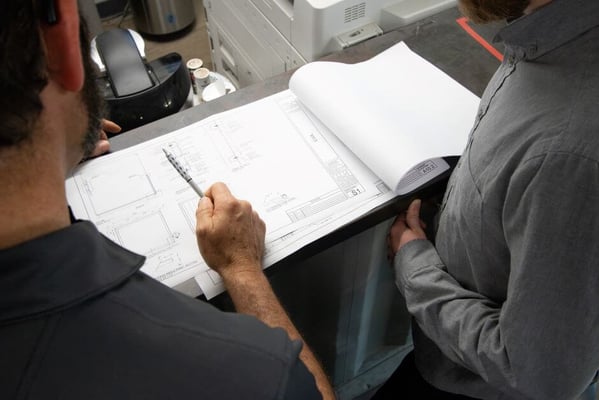
Quick Definition: The A3 methodology is a lean management framework—named for the 11″×17″ A3 paper it is documented on—that condenses an entire problem-solving cycle (problem identification, root cause analysis, solution design, implementation, and review) onto a single page. Originally developed by Toyota as part of the Toyota Production System, it is widely used across manufacturing and operations to drive structured continuous improvement.
Falcon Structures operates at a unique intersection: the work our team performs—framing, drywall, electrical—mirrors what you’d see on any construction site. Yet to unlock the full value of our modular approach to modified shipping containers, we must think and act like a manufacturer. Bridging that gap requires the right tools. For Falcon, one of the most impactful is the A3 methodology.
What is the A3 methodology?
Created by Toyota—the benchmark for lean manufacturing excellence—the A3 methodology gets its name from the 11″×17″ A3 paper format. It is a lean management tool that compresses an entire problem-solving process onto a single page, enforcing clarity and focus at every stage.
At Falcon Structures, the A3 methodology was adopted and adapted by Brian Dieringer, Co-Founder and Executive Vice President of Products. Brian has led its implementation across Falcon’s manufacturing floor—and the results speak for themselves.

Applying A3 Methodology to Modified Shipping Container Manufacturing
Falcon’s A3 process follows five structured phases. Each phase is completed in sequence and documented on a single A3 sheet that is posted in the facility for ongoing reference.
1. Identify the Problem
When a significant defect—or “bust,” in Falcon’s terminology—occurs, the relevant team assembles for an in-person root cause meeting. Attendees typically include department heads, production leads, and quality control personnel: those who hold “system responsibility” for the affected area.
“We try to get people that have a level of system responsibility, and then part of that is also to demonstrate the mindset that we’re not here to assign blame.”
— Brian Dieringer, Co-Founder & EVP of Products, Falcon Structures
2. Analyze the Root Cause
Root cause analysis is the intellectual core of A3. The goal is not theoretical—it is to determine precisely what happened, why it happened, and why the system allowed it to happen. Common techniques include:
- Data gathering from the production process
- Cross-functional team input
- The “5 Whys” technique—repeatedly asking “And why did that happen?” to trace a defect back to its systemic origin
“It’s not intended to be theoretical. It’s intended to determine what really happened. Why did that happen, and why did we allow that to happen?”
— Brian Dieringer
Root causes at Falcon have ranged from the straightforward (an employee needing additional training) to the systemic (a flawed process no one had previously identified). Brian recounts one pivotal session:
“The things we identified were not just work habit or sloppy. I think we identified some real systemic issues. It wasn’t until we sat down and got into that creative space that we recognized something no one was thinking about.”
— Brian Dieringer

3. Develop Solutions
With the root cause identified, the team brainstorms solutions and evaluates the feasibility of each. The most promising candidates are selected and structured into an action plan. Solutions at Falcon have ranged from investing in upgraded tooling to fundamentally redesigning a department’s workflow.
“We want to get better results, but what we have control over is our actions that lead to those results. So let’s experiment and try and see what happens.”
— Brian Dieringer
4. Implement the Plan
Each solution is treated as a structured experiment. A single owner is assigned to oversee implementation—responsible for executing the plan and tracking results over a defined period, not for guaranteeing outcomes. For example, Falcon’s head of quality control may own supplemental quality checks after a key production phase, running those checks for a set window and then reporting back to the group.
5. Assess the Results
Approximately one month after the initial A3 meeting, the team reconvenes to evaluate outcomes. This review is collaborative: did the solutions work? Were processes meaningfully improved? If so, the learning is documented. If not, the team iterates.
“That’s really where you get the best out of the process—when you come back later and revisit it and say, hey, how did this go?”
— Brian Dieringer
Once completed, the A3 sheet is physically posted in Falcon’s Building 2—a visible, ongoing reminder of the commitment to continuous improvement.
“We try to refer back to it. That’s the whole point of it being on this large sheet of paper, so that you could actually post it as something that we’re working to continuously improve.”
— Brian Dieringer

How Effective Is the A3 Methodology at Falcon Structures?
The effectiveness of A3 varies by organization and how thoroughly it is adapted to context. For Falcon, the results have been significant—particularly given the challenge of running a manufacturing operation staffed largely by construction-trade professionals.
“First of all, it helped us to emphasize the fact that we’re trying to do a manufacturing process when we’ve got construction-trade people. We’re trying to understand and utilize tools to get manufacturing quality and efficiency, all while doing construction trades.”
— Brian Dieringer
For Falcon, A3 is not simply a quality tool—it is a strategic commitment to becoming a learning organization. In an industry where inefficiency is endemic, that commitment is a competitive differentiator.
“We’re trying to be a learning organization. This is one of our tools to learn. We’re going to make mistakes, but we can together work on getting better.”
— Brian Dieringer
Want more insights like this?
Follow our LinkedIn newsletter for modular trends, project takeaways, and practical guidance to navigate 2026 and beyond.
Frequently Asked Questions About the A3 Methodology
What is the A3 methodology in simple terms?
The A3 methodology is a structured, one-page problem-solving framework developed by Toyota. It guides a team through five phases—identifying a problem, finding its root cause, developing solutions, implementing those solutions, and reviewing results—all documented on a single 11″×17″ sheet of paper. Its compact format enforces clarity and discourages vague or overcomplicated thinking.
Why is it called the “A3” methodology?
The name comes from the A3 paper size (11 inches by 17 inches, also called ledger or tabloid in the U.S.). Toyota chose this format deliberately: fitting an entire problem-solving cycle on one page forces conciseness and keeps teams focused on the most important information.
How does Falcon Structures use the A3 methodology?
Falcon Structures applies A3 whenever a significant manufacturing defect (internally called a “bust”) occurs. A cross-functional team—including department heads, production leads, and quality control—meets in person to document the problem, conduct a root cause analysis, design experiments (solutions), assign ownership, implement changes, and then reconvene roughly one month later to assess results. Completed A3 sheets are posted in the facility as a visible commitment to continuous improvement.
What is the difference between A3 and the 5 Whys?
The 5 Whys is a root cause analysis technique—a tool used within A3. The A3 methodology is a complete problem-solving framework that includes the 5 Whys as one component of its root cause analysis phase. In other words, A3 is the process; the 5 Whys is one technique applied during that process.
Can the A3 methodology be used outside of manufacturing?
Yes. While A3 originated in Toyota’s manufacturing operations, it has been adopted across healthcare, software development, logistics, and services. Any organization that needs a structured, repeatable approach to diagnosing and resolving problems can benefit from A3.
How does A3 benefit customers of Falcon Structures?
By systematically identifying and eliminating root causes of defects and inefficiencies, A3 allows Falcon to improve product quality, reduce costs (which helps keep pricing competitive), and deliver projects on schedule. These improvements directly benefit customers through better-built modified shipping containers delivered on time and at a fair price.



RELATED BLOGS

Thoughts on Manufacturing Leadership in Difficult Times
Marissa Morin | May 13, 2020 | 3 min read
READ MORE
7 Benefits of Containerized Equipment Shelters for OEMs
Krista Short | Jul 6, 2017 | 3 min read
READ MORE
What Are the Benefits of Lean Manufacturing? (From a Company Applying It)
Marissa Morin | May 3, 2023 | 3 min read
READ MORE