Most companies think about facilities as overhead, just sunk costs and the price of doing business. That’s understandable if you operate in predictable environments with long-term, fixed locations. Industries like construction, energy, and utilities, however, don’t operate in stable environments.
Work moves, headcounts shift, projects open and close, and demand swings quarter to quarter. When the work moves faster than the buildings do, traditional facilities become a drag on the business.
In my experience, executives in these agile industries too often miss that site facilities behave more like operating inputs than permanent real estate. When you treat them strategically, they can become real operating leverage: reducing variable costs, matching capacity to demand, and preserving capital when volatility hits.
Fixed-Asset Thinking in a Variable-Work World
Temporary facilities like job site offices, control rooms, break spaces, and housing are usually managed like long-lived, immovable assets. In reality, they’re some of the most flexible levers you have for improving project performance and protecting margins.
Here’s where the disconnect comes up:
- Permanent buildings become an albatross the moment a site shuts down
- Trailer rentals drain operational expenses (OPEX) month after month, with nothing retained
- One-off structures end up abandoned or sold for a fraction of their cost.
None of these options match the way most field-based businesses actually operate. When your revenue is mobile but your facilities aren’t, you’re absorbing avoidable cost every time.
Facilities as Operating Leverage: The Financial Case Executives Shouldn't Ignore
Executives in cyclical or project-based industries constantly deal with demand changes. The companies that stay resilient are the ones that flex their resources up and down without burning capital or sacrificing operational readiness. That’s where relocatable, modular assets create leverage.
1. Lower Variable Costs
You eliminate recurring rental fees, reduce maintenance spend, and standardize setups across sites. Less variation means fewer surprises.
2. Flex with Demand
When work moves, the facility moves with it. When crews scale up or down, the infrastructure follows. You’re not stuck with facilities that outlive the project.
3. Preserve Capital
You buy once, then redeploy the asset for years. Instead of tying up capital in site-specific builds or wasting money renting assets you’ll never own, you leverage your balance sheet to create more flexiblility.
4. Protect Margins
In downturns, reusable assets reduce write-offs. In upturns, they get crews operational fast, reducing delays that eat into profitability.
The real drain? Stranded assets, or anything you paid for that can’t be used again. Think of the building left behind at a closed site, the run-down trailer not worth relocating, or the custom structure that doesn’t fit the next project. If your facilities can’t redeploy, they’re eroding return on invested capital and weakening financial agility.
Where Modular Container Structures Fit
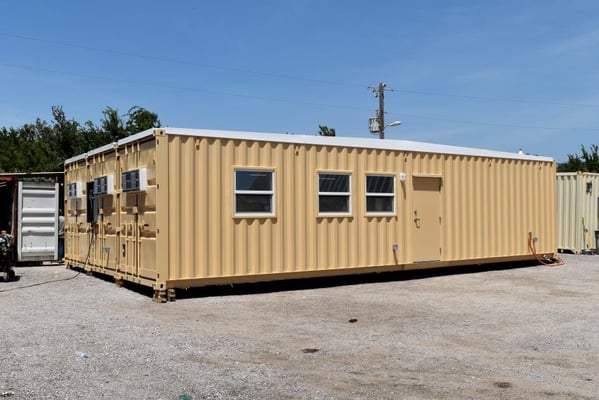
Portable container-based structures behave the way field-based businesses behave: dynamic, mobile, and durable.
Repurposed Across Dozens of Sites - A single container office or housing unit can serve multiple projects over its lifetime, maximizing utilization instead of starting over on every site.
Predictable Depreciation, Predictable ROI - Steel construction holds value. Containers typically fully depreciate in seven years but can last 25 years with minimal maintenance. That’s 18 years of financial benefit when the next option is 25 years of trailer rentals.
Lower Total Cost of Ownership - Spend less money maintaining and more time using your structure. Fewer repairs, less vulnerability to weather or vandalism, and easier relocation are a few of the benefits of container structures.
Standardization Across Sites - Container structures can be standardized across layouts, power requirements, and more. That consistency leads to more efficient onboarding, smoother inspections, and fewer operational surprises.
The Practical Path to Stronger Margins
If your business opens and closes sites, shifts crews, or works in markets where weather, seasonality, and demand change the plan week to week, your facilities shouldn’t behave like fixed assets. They need to move with the work.
That’s where relocatable, modular structures give you a real advantage. They let you mobilize faster, support crews immediately, and pass inspections on predictable layouts—so you can start generating revenue sooner and avoid the downtime that quietly erodes margins. None of this is about cutting corners. It’s about eliminating the drag that comes from infrastructure that can’t keep up.
When your facilities can be redeployed instead of abandoned, you reduce waste, avoid stranded assets, and preserve capital for the things that truly drive performance. You stay lighter, more resilient, and better positioned for whatever the next project brings.
About the author: John McAlonan is the President and COO of Falcon Structures. You can follow him on LinkedIn.
Want more insights like this?
Follow our LinkedIn newsletter for modular trends, project takeaways, and practical guidance to navigate 2026 and beyond.